

What is the Science Based Targets initiative (SBTi)?
The Science Based Targets initiative (SBTi) is a global partnership between CDP, the United Nations Global Compact, World Resources Institute (WRI), and the World Wide Fund for Nature (WWF). It provides corporations with a rigorous, independent framework to set emission reduction targets that align with climate science. According to the SBTi Corporate Net-Zero Standard, targets are considered "science-based" only if they are in line with what the latest climate science deems necessary to meet the goals of the Paris Agreement—specifically, limiting global warming to 1.5°C above pre-industrial levels (Science Based Targets initiative [SBTi], 2024).
In early 2026, the SBTi released its Trend Tracker, noting that corporate climate target-setting surged by 40% in 2025, with Asia emerging as a "center of gravity" for new commitments (SBTi, 2026). For Thai businesses, this means that SBTi alignment is no longer a niche sustainability play; it is becoming a requirement for participating in global trade.
Why International Investors Care
Institutional investors now treat carbon as a financial liability. Major global investment firms utilize SBTi validation as a primary "litmus test" for corporate resilience. A company without an SBTi-validated target is increasingly viewed as high-risk because it lacks a credible, transparent plan for a low-carbon economy (Riedel, 2024).
Furthermore, the SBTi (2024) emphasizes that science-based targets prevent "greenwashing" by providing a consistent definition of what "Net-Zero" actually means. Without this common standard, targets often differ in the emission sources they include and the speed of their reductions, creating confusion and legal risk for companies and investors alike.
The 4 Pillars of a Net-Zero Target
Under the Corporate Net-Zero Standard (V1.3), a complete science-based target is not just a single goal; it consists of four distinct pillars (SBTi, 2024):
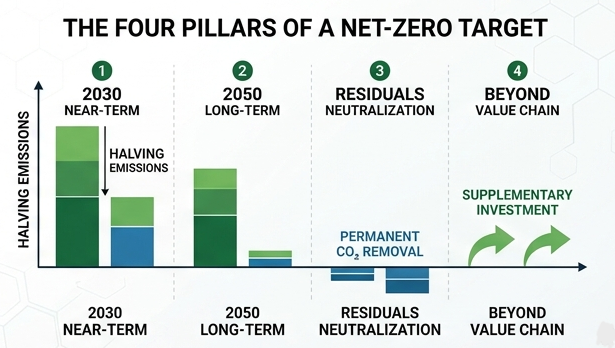
1. Near-term Targets: Companies must commit to rapid, deep emission cuts by 2030. This usually requires roughly halving total emissions within this decade.
2. Long-term Targets: Companies must set a goal to reduce all possible emissions—usually at least 90%—by 2050 at the latest.
3. Neutralization of Residual Emissions: After reaching a 90% reduction, companies must use permanent carbon removal (not just avoidance) to counterbalance the final 10% of "hard-to-abate" emissions.
4. Beyond Value Chain Mitigation (BVCM): SBTi recommends that businesses invest in mitigation outside their own value chain while they are reducing their own emissions, though this does not count toward the 90% reduction goal.
The 5-Step Process for Thai Corporations
1. Commit: Submit a letter of intent via the new SBTi Services portal to be added to the public Target Dashboard.
2. Develop: Calculate a comprehensive GHG inventory and use the Corporate Net-Zero Tool to model your reduction pathways (SBTi, 2024).
3. Submit: Present your targets for official validation. For Thai firms, this is now handled by the wholly-owned subsidiary, SBTi Services Limited (SBTi, 2026).
4. Communicate: Announce your validated targets to investors and customers.
5. Disclose: Report emissions and progress against targets annually to ensure continued accountability.
Streamlined Pathways for Thai SMEs
SBTi recognizes that Small and Medium-sized Enterprises (SMEs) often have fewer resources. The SME Streamlined Route allows firms with fewer than 250 employees to bypass the initial commitment phase and jump straight to setting pre-approved targets for Scope 1 and 2, with a simplified requirement for Scope 3 (Söderberg & Bergkvist, 2024).

References
- Giesekam, J., Norman, J., Garvey, A., & Betts-Davies, S. (2021). Science-based targets: On target? Sustainability, 13(4), 1657. https://doi.org/10.3390/su13041657
- Riedel. (2024). The business of climate change: Changing sources of green capital accumulation in the coffee sector. Taylor & Francis. https://www.tandfonline.com/doi/full/10.1080/13563467.2026.2614691
- Science Based Targets initiative. (2024). The Corporate Net-Zero Standard (V1.3). https://sciencebasedtargets.org/net-zero
- Science Based Targets initiative. (2026, April 9). Corporate climate target-setting up 40% in 2025, with Asia emerging as a centre of gravity. https://sciencebasedtargets.org/news/corporate-climate-target-setting-up-40-in-2025
- Söderberg, F., & Bergkvist, M. (2024). Setting science based targets and adapting company operations and activities. Mälardalen University. https://www.diva-portal.org/smash/get/diva2:1864924/FULLTEXT01.pdf